
Civil Engineering


ABOUT
The Civil Engineering Program strengthens the construction sector by providing students with a solid foundation in design and construction, supported by strong technical expertise. In addition, students develop leadership, process management, and cost-control skills, enabling them to create eco-friendly projects that deliver innovative and creative solutions to global construction challenges.
Graduates of the Civil Engineering Program stand out for their comprehensive approach and innovative capacity to address challenges in the construction sector. With a strong foundation in science, engineering, research, and management—combined with a collaborative and multidisciplinary perspective—they apply Information and Communication Technologies (ICT) to manage infrastructure projects efficiently and sustainably throughout the entire asset life cycle.
Their commitment to excellence is reflected in their ability to integrate technical, global, and social perspectives into project design and implementation, ensuring a positive impact on communities.
Mission
We train leading civil engineers capable of designing, building and managing sustainable infrastructure that fosters economic development, technological innovation, and the comprehensive well-being of society.
Vision
To stand out in Latin America for training civil engineers recognized for their leadership, sustainable mindset, technological innovation, and positive impact on economic and social development.
The Program Educational Objectives (PEO) outline the key milestones every civil engineer must achieve, based on insights from employers, alumni, faculty, and students.
Civil Engineering graduates from Universidad de Lima achieve the following PEOs:
- PEO 1: Demonstrate mastery of technical skills for planning, analyzing, designing, constructing, supervising, operating, and maintaining infrastructure.
- PEO 2: Excel in project management and teamwork, leveraging ICT to develop valid, creative, innovative, and sustainable technical solutions for the efficient management of infrastructure projects.
- PEO 3: Lead confidently and communicate effectively within multidisciplinary teams throughout all stages of infrastructure project management.
- PEO 4: Commit to lifelong learning and the integration of emerging technologies in infrastructure management.
- PEO 5: Engage in innovation and research to address engineering challenges with a focus on continuous improvement.
- PEO 6: Practice with a strong ethical foundation and a sense of social responsibility, contributing to sustainable development in organizations and communities.
Student Outcomes (SO) define the competencies that Civil Engineering students at Universidad de Lima develop throughout their academic training. The following outcomes describe the specific abilities they are expected to achieve:
- SO1: Ability to identify, formulate, and solve complex engineering problems by applying principles of engineering, science, and mathematics.
- SO2: Ability to apply engineering design to produce solutions that meet specified needs while considering public health, safety, and welfare, as well as global, cultural, social, environmental, and economic factors.
- SO3: Ability to communicate effectively with diverse audiences.
- SO4: Ability to recognize ethical and professional responsibilities in engineering contexts and make informed judgments that consider the global, economic, environmental, and societal impact of engineering solutions.
- SO5: Ability to work effectively on a team that provides leadership, fosters collaboration and inclusion, establishes goals, plans tasks, and achieves objectives.
- SO6: Ability to design and conduct appropriate experiments, analyze and interpret data, and apply engineering judgment to reach valid conclusions.
- SO7: Ability to acquire and apply new knowledge as needed, using suitable learning strategies.

CURRICULUM
This is a flexible curriculum that balances science, technology and the humanities. It also includes business management courses to ensure the comprehensive training of professionals capable of addressing the challenges involved in the design, construction, supervision, and maintenance of diverse types of infrastructure.
ACADEMIC DEGREES AND PROFESSIONAL TITLES
Universidad de Lima grants the Bachelor's degree in Civil Engineering and the professional title of Civil Engineer. For more information, refer to the following documents:
Requirements:
- Successfully complete 205 credits, with at least 103 credits earned at Universidad de Lima.
- Fulfill all obligations and commitments to the University.
Requirements:
- Hold the graduate status in Civil Engineering.
- Submit a certificate of pre-professional internship (six cumulative months).
- Demonstrate proficiency in a foreign or native language through a certificate issued by an institution recognized by Universidad de Lima.
- Successfully complete a final-level research course, which includes a specialized research project.
- Fulfill any additional requirements established by Ulima regulations.
- Complete the administrative process to obtain the Bachelor's diploma.
Procedure:
Complete the administrative process via Mi Ulima portal to obtain the Bachelor's diploma. For a full guide, click here.
Requirements:
- Hold the Bachelor's degree in Civil Engineering.
- Successfully complete one of the options to obtain the professional title.
- Complete the administrative process to obtain the professional title diploma. For more information, click here.
Complete the administrative process via Mi Ulima portal to obtain the professional title. For a full guide, click here.
Modality I: Thesis
- Submodality A: Submit a publishable research paper developed in the Research Seminar II course.
- Submodality B: Develop a thesis on a new topic.
- Submodality C: Submit a published or accepted research paper in an indexed journal—preferably Scopus or Web of Science—or in an indexed academic conference.
Modality II: Professional Proficiency Project
The Civil Engineering Program offers 4 Specialist Certifications:
- Virtual Design and Construction
- Structures
- Collaborative Project Management
- Transportation and Geotechnics
Requirements:
- Hold a Bachelor's degree.
- A weighted average of no less than 13.00 across the required courses.
- Successfully complete all Specialist Certification courses within a maximum of two attempts.
- Complete at least three months of pre-professional internships in the area related to the Specialist Certification or an equivalent activity.
School of Engineering
Civil Engineering Program
Academic Degrees and Professional Titles Office
Building O1, Floor 11
Phone: +511 4376767 ext. 37115
gytcivil@ulima.edu.pe
SPECIALIST CERTIFICATIONS
For more information, click on the links below:
This Specialist Certification provides students with the necessary competencies for the analysis and design of geotechnical structures, soil–structure interaction, and slope stability. It also covers the geometric design of highways and the use of digital technologies for georeferenced data management. Additionally, it focuses on the evaluation and design of road infrastructures, emphasizing sustainability, efficiency, and pavement durability.

This Specialist Certification provides students with the VDC methodology, which comprises Integrated Concurrent Engineering (ICE), Building Information Modeling (BIM), and Product Production Management (PPM). Through courses such as Construction Project Management, Operations and Maintenance, and Productivity in Sustainable Projects and Infrastructure, students acquire the necessary skills to develop performance indicators, optimize processes, and evaluate the sustainability of infrastructure projects. Upon completion, graduates are prepared to lead construction, operation, and maintenance projects with an innovative, sustainable, and efficient approach, leveraging advanced technological tools and modern collaborative techniques.

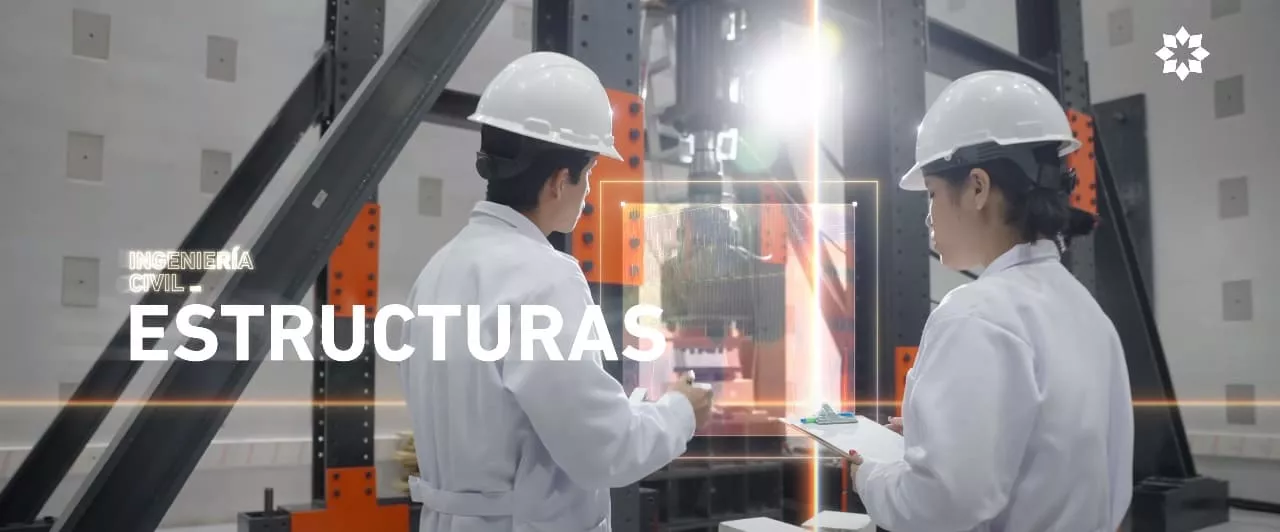
This Specialist Certification provides students with the knowledge and skills to analyze and design reinforced concrete, steel, and masonry structures that are seismic-resistant throughout their life cycle. Students will master concepts related to the behavior of concrete, structural steel, and masonry, as well as structural modeling, analysis, and design under diverse environmental conditions. This comprehensive approach ensures a solid understanding of the entire structural design process.
This Specialist Certification provides students with the competencies required for the comprehensive management of construction, operation, and maintenance projects. It emphasizes the creation of control indicators for scope, schedule, cost, and risk management. The program also develops skills in BIM and VDC methodologies to enhance collaboration and project performance. Additionally, students apply the Lean methodology to increase productivity and evaluate infrastructure sustainability through water and energy efficiency tools and Life Cycle Assessment (LCA) methods aligned with sustainability certifications.

PARTIAL CERTIFICATIONS


AGREEMENTS
CONSORCIO DE UNIVERSIDADES
It is a non-profit civil organization comprising Pontificia Universidad Católica del Perú, Universidad del Pacífico, Universidad Peruana Cayetano Heredia and Universidad de Lima. This partnership allows students from these four institutions to access academic and university services, premises, validated courses, and credit equality for courses taken in any university of this Consortium.
Optional Second International Bachelor's Degree
Universidad de Lima offers students the opportunity to develop in global environments, enhance their networking, and live an international experience through the optional second international bachelor’s degree programs.
University of London
Thanks to the agreement between Universidad de Lima and University of London (UOL), internationally recognized for its high academic standards, students can obtain a second international bachelor’s degree without leaving the country: Bachelor of Science in Business Administration. This program is available to students from all undergraduate programs at Universidad de Lima.
Information: uol@ulima.edu.pe


PUBLICATIONS
The Publishing Fund publishes works that represent the intellectual and research contributions of Ulima professors. It aims to engage the community through the dissemination of ideas and knowledge across diverse disciplines. Learn more about our publications.
Find all academic output from members of the Civil Engineering Program online. Click on each item for more information.
- Books and articles from Civil Engineering professors and researchers
- Civil Engineering thesis: professional title
This Spanish edition of Integrating Project Delivery by Martin Fischer, Howard Ashcraft, Dean Reed, and Atul Khanzode is the first book-length discussion of the IPD methodology. It integrates structure, process, technology, and behavior to enable high-performance collaborative projects. The book serves as a valuable resource for students and professionals in architecture, engineering, construction, and operations seeking to understand the value of IPD. It also examines the legal frameworks that support this approach and includes case studies showcasing how leading companies implement IPD. Alexandre Almeida was responsible for the foreword and coordination of the Spanish translation.
Directory

Nadia Rodríguez Rodríguez
Dean
T: +511 4376767 ext. 34400
nrodrigu@ulima.edu.pe

Edgar Valcárcel Pollard
Program Director
T: +511 4376767 ext. 37100
evalcar@ulima.edu.pe

Andrei Gilberto Domínguez Alvarado
Academic Secretary
T: +511 4376767 ext. 37150
agdoming@ulima.edu.pe

Luis Gabriel Quiroz Torres
Academic Degrees and Professional Titles Coordinator
T: +511 4376767 ext. 37115
lquiroz@ulima.edu.pe

Marck Steewar Regalado Espinoza
Internship and Employability Coordinator
T: +511 4376767 ext. 37106
msregala@ulima.edu.pe
ADVISORY COUNCIL
Hugo Scaletti Farina
Scaletti holds a PhD and an MSc in Civil Engineering from the Massachusetts Institute of Technology (MIT), as well as a Civil Engineering degree from Universidad Nacional de Ingeniería (UNI). His accolades include the Antorcha de Habich (2005) from UNI, the Medal of the Lima Departmental Council (2003) from Colegio de Ingenieros del Perú (Professional Board of Engineers of Peru), and the COSAPI Innovation Award (2002). He is currently a Full Professor in the School of Civil Engineering at Universidad Nacional de Ingeniería.
Leonardo Antonio Rischmoller Delgado
Rischmoller holds a PhD in Engineering Sciences from Pontificia Universidad Católica de Chile, completed postdoctoral training in Virtual Design and Construction (VDC) at Stanford University, and earned an Executive MBA from UC Berkeley. He obtained his Civil Engineering degree from Universidad Ricardo Palma in Peru. As a Business Analyst at DPR Construction (USA), a board member of COSAPI, and Chair of the Innovation, Technology, and Processes Committee, he is leading advancements in the fields of engineering and construction.
Luis Miguel Bozzo Rotondo
Bozzo holds a PhD and an MSc in Civil Engineering from UC Berkeley, as well as a Civil Engineering degree from Universidad Nacional de Ingeniería (UNI). He currently leads Luis Bozzo Estructuras y Proyectos, based in Barcelona, Spain.
WORK REPOSITORY
Compilation of the most outstanding works from our students. This repository's goal is to boost the research spirit and disseminate contributions produced by Ulima community members.
Faculty
At Universidad de Lima, our faculty members bring together academic excellence, professional expertise, and a passion for teaching. They inspire students to think critically, conduct meaningful research, and lead with integrity, creating a lasting impact on their professions and communities.
BIM-VDC CULTURE
INTRODUCTION
The Civil Engineering Program at Universidad de Lima stands out for its distinctive BIM-VDC approach. This culture goes beyond the integration of the methodology across the curriculum. Through this program, Universidad de Lima also participates in various national and international organizations and institutions that have a significant impact on Peruvian society.
BUILDING INFORMATION MODELING (BIM)
BIM promotes the integration of construction processes, work planning, material logistics, costs, budgets, management, value engineering, and building lifecycle through three-dimensional digital models driven by data. Consequently, a BIM model includes not only graphic representations but also technical features such as interference detection, quantity take-offs, budgeting, surface measurements, 3D views, and energy or structural analysis and calculations.
The courses in the Civil Engineering Program are designed to be interconnected, allowing students to establish meaningful links between contents. One of the main challenges of traditional curricula is the lack of opportunities for students to integrate knowledge and apply it to real engineering problems, often resulting in limited abstract reasoning and 3D problem-solving skills.
In response, the Civil Engineering Program at Universidad de Lima aligns its courses with the needs of national companies. To achieve this, the areas of study are organized into three fields of action—Construction and Architecture, Structures, and Management—which are most closely related to the use of building information systems. This process is supported by the application of BIM methodologies and advanced digital tools that connect theoretical learning with real-world practice.
By integrating this methodology into the curriculum, Civil Engineering students at Universidad de Lima can obtain partial certifications corresponding to each BIM dimension as they progress through their studies:
- 3D BIM: Development of three-dimensional architectural and structural models with embedded information.
- 4D BIM: Incorporation of the time factor for the virtual construction of three-dimensional architectural and structural projects.
- 5D BIM: Inclusion of cost data for the elements comprising the virtual model.
- Peruvian architects based in Canada discussed the BIM methodology in a webinar (October 10, 2017)
- An expert delivered a talk on the BIM methodology (March 13, 2018)
- Civil Engineering Program: a leader in promoting the BIM model (July 11, 2018)
- Alexandre Almeida authored an article on the benefits of BIM, published in the Journal of the College of Engineers (October 10, 2018)
- Director Alexandre Almeida participated in a BIM technology event (November 30, 2018)
- Director Almeida emphasized the role of BIM in Peru in his column for RPP (April 12, 2019)
VIRTUAL DESIGN AND CONSTRUCTION (VDC)
The Virtual Design and Construction (VDC) methodology integrates design, construction, and operation from the early stages of a project through the use of BIM models. Its goal is to define, align, and achieve objectives while reducing the unnecessary use of resources such as time, capacity, inventory, and costs throughout all project phases.
- Engineering modeling methods: product, organization and process
- Model-based analysis and design methods: quantity take-offs, schedules, costs, process risks (BIM tools)
- Information visualization methods
- Business metrics and strategic management approach
- Economic impact analysis: cost and value models for capital investments
In addition to the fundamental BIM tool, VDC is supported by Project Production Management (PPM). The detailed monitoring of virtual information and metrics generated through both BIM and PPM feeds into decision-making sessions known as ICE (Integrated Concurrent Engineering)—the key catalyst of this methodology.
This approach offers multiple advantages throughout the construction process, both in virtual and physical environments. It enhances collaboration among project stakeholders and, as a result, saves time and costs by reducing design conflicts and improving the accuracy of information for informed decision-making.
- Universidad de Lima hosted a talk on the VDC Program (December 4, 2018)
- Perú Construye and Construir featured the launch of the VDC Program at Universidad de Lima (December 19, 2018)
- Stakeholders journal covered the third edition of the VDC Program (January 25, 2019)
- Director Alexandre Almeida spoke with CIP TV about the VDC Program (February 8, 2019)
- Ulima delivered a talk on Collaborative Management and VDC (February 19, 2019)
- A VDC Program expert gave an online lecture for Ulima (February 21, 2019)
- A VDC Program advisor published an article in Constructivo journal (March 1, 2019)
- The Canada–Peru Chamber of Commerce announced the launch of the VDC Program (March 5, 2019)
- The Civil Engineering Program launched the International Workshop as part of the third edition of the VDC Program (March 6, 2019)
- The International Workshop of the third edition of the VDC Program concluded successfully (March 13, 2019)
- The third edition of the VDC Program in Peru was officially inaugurated (March 18, 2019)
STANFORD CIFE ALLIANCE
Stanford University’s Center for Integrated Facility Engineering (CIFE) is the world’s leading research center for Virtual Design and Construction (VDC) in the fields of architecture, engineering, and construction. The VDC methodology was developed by this prestigious center to promote the development, learning, and application of VDC principles and methods that help projects deliver exceptional value and enable member organizations to achieve innovation in design, construction, and project management.
As a result of the Third Virtual Design and Construction Program and as part of the Civil Engineering Program’s BIM culture, Universidad de Lima has established an alliance with CIFE. This partnership has made the University the only institution in Latin America that is a member of this prestigious organization, alongside leading companies and academic institutions in the use and implementation of this technology, such as Autodesk, Google, Project Production Institute, and Hilti, among others.
This alliance is essential for Universidad de Lima, as it brings two major advancements: research and education.
In terms of research, CIFE collaborates with member organizations to document challenges, develop, and test innovative methods that enable the modeling, visualization, analysis, and evaluation of the multidisciplinary performance of design and construction projects, as well as the validation of results.
In terms of education, the objective is to enhance knowledge and competencies for applying VDC methods and understanding their value and cost implications for both professionals and students.
How is this achieved? Through academic exchange programs for students, professors, and researchers with Stanford University; access to projects implemented by CIFE itself under the VDC methodology; and the opportunity to offer a VDC Program designed to train professionals in the construction industry through the use of new technological tools.
INACAL
Through its Civil Engineering Program, Universidad de Lima participates as a member of multiple committees of the National Quality Institute (INACAL), which operates under the Ministry of Production. Together with representatives from the public, private, and academic sectors, the University contributes to the development of technical standards. Specifically, Universidad de Lima is part of the Technical Committee for Standardization (CTN) of Buildings and Civil Engineering Works, and the Technical Subcommittee for Standardization (SCTN) on Information Management and Quality in Construction Works.
These committees aim to develop Peruvian Technical Standards (NTP) that regulate quality and promote safety in construction, thereby reducing the risk of accidents during earthquakes or other disasters. Their mission is to propose standards aligned with established guidelines and best practices to ensure construction quality. To achieve this, they consider technical, environmental, social, economic, innovation, and occupational health aspects.
On the progress achieved, Engineer Alexandre Almeida, Director of the Civil Engineering Program and Technical Secretary of both the CTN and SCTN, stated:
“Quality buildings are crucial to guaranteeing safety. Together with the institutions that form the technical committee and subcommittee, we are working to develop Peruvian Technical Standards that ensure safe housing, addressing every phase from design and planning to production and material use.”
MINISTRY OF HOUSING, CONSTRUCTION AND SANITATION
Through its Civil Engineering Program, Universidad de Lima is part of the BIM Committee of the Construction Office of the Ministry of Housing, Construction and Sanitation (MVCS). This participation recognizes the University’s innovative proposal to comprehensively implement the BIM methodology within its curriculum. The committee also includes experts from the Office of the Comptroller General of the Republic of Peru, professionals from various government sectors—including housing, interior, transportation, economy, and education—and representatives from private organizations and academic institutions.
The BIM Committee is working on the creation of a new national technical standard that will guide project development through the BIM methodology. The initiative seeks to unify the basic technical features every BIM model should include. The upcoming standard, known as BIM Model, will align Peru with global practices for collaborative construction work.
Aimed at public entities, the regulation will encourage the use of BIM-based processes in procurement, improving resource management while saving time and costs. The BIM model has been applied in Peru since 2010, and standardizing its use will help boost efficiency and coordination in construction projects.
STUDY CIRCLES
ACTIVITIES
VDC INTERNATIONAL CONFERENCE
This international initiative fosters the exchange of academic and professional experiences on the application of the VDC methodology to improve efficiency within the construction sector.
Information
vdc@ulima.edu.pe
Website

EXPO INVESTIGACIÓN
In line with institutional policies, the Civil Engineering Program strengthens a research-driven culture by encouraging students and professors to explore solutions to modern engineering challenges. Through Expo Investigación, the most outstanding research papers from this undergraduate program gain visibility and promote innovative applications that contribute to social progress. Since 2020, Expo Investigación has featured a virtual platform that displays the best student projects.

ENGINEERING WEDNESDAYS
Engineering Wednesdays are regular events that explore various specializations and areas of interest within the field. These sessions foster professional development and knowledge exchange among students, professors, and industry experts. They also provide an ideal space to discuss relevant topics, showcase projects, and host specialized workshops that contribute to the comprehensive development of future engineers.

VDC INTERNATIONAL PROGRAM
Stanford University's Center for Integrated Facility Engineering (CIFE) developed the VDC program to design and implement projects through a virtual platform, allowing traditional project management challenges to be resolved before the construction phase. Through an alliance with the Stanford Center for Professional Development, the Civil Engineering Program at Universidad de Lima offers the Virtual Design & Construction (VDC) Certification Program. This program, delivered entirely in Spanish, is fully practical and the only one of its kind in Latin America.

LIFELONG LEARNING
Keep your competencies, skills and knowledge updated throughout your entire professional life.
Our master's and doctoral programs focus on training interdisciplinary professionals who promote innovation, entrepreneurship and research.
The Executive Education Office (DEC) at Universidad de Lima offers workshops, courses, and specialization programs to train executives, professionals, and business leaders in key areas of management.
If you wish to study abroad, this is the right place to find all relevant information about scholarships and academic opportunities.
The Ulima Language Center equips students with the skills and knowledge needed to communicate effectively in English across diverse contexts. Below are some of our programs:
LABORATORIES
NEWS AND INTERVIEWS
AGENDA
We have no upcoming events for this area.