
Mechatronics Engineering


ABOUT
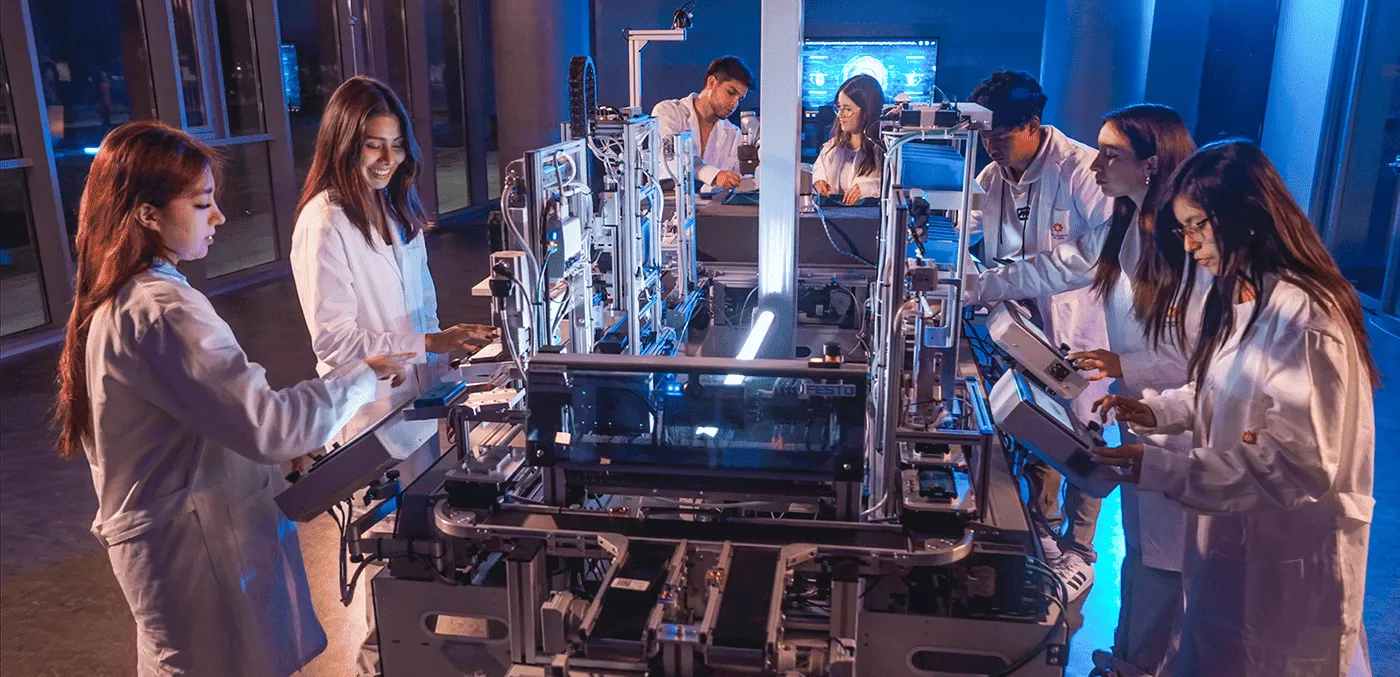
The Mechatronics Engineering Program prepares well-rounded professionals who contribute to industrial transformation through the use of advanced technologies, including robotics, automation, and AI. Our graduates design and implement automatic systems that increase competitiveness and efficiency across multiple productive sectors. By integrating mechanics, electronics, and control, they create innovative and sustainable solutions that drive technological progress and strengthen the future of smart systems.
Professionals capable of designing, simulating, developing, and integrating state-of-the-art machines and automatic systems. Their theoretical and practical knowledge enables them to introduce innovation into productive processes through the synergy of mechanics, electronics, programming, and control, thus strengthening organizational competitiveness.
Mission
We prepare innovative mechatronics engineers capable of integrating robotics, automation, and AI to design and advance smart systems. We foster sustainable development and industrial competitiveness through academic excellence focused on technological solutions with global impact.
Vision
To stand out in Latin America and Peru for training mechatronics engineers who transform the industry through smart and sustainable systems, fostering innovation and technological development.
CURRICULUM
This flexible curriculum combines sciences, technology, and the humanities, along with management courses that strengthen the preparation of professionals ready to face challenges in automation, control, robotics, Industry 4.0, machine design, monitoring, and industrial equipment maintenance.
The Mechatronics Program comprises 205 credits (190 mandatory and 15 elective) distributed across 10 academic terms.
SPECIALIST CERTIFICATIONS
This Specialist Certification provides students with knowledge to transform industrial processes using advanced solutions. It addresses key technologies such as pneumatics, industrial networks, autonomous systems, gripper design, SCADA, and computer vision. It also prepares students to design and implement smart systems that optimize processes, boost operating efficiency, and revamp industrial robotics through a practical approach.
For more information, click here.
This Specialist Certification provides key competencies to lead digital transformation through big data, cybersecurity, VR and AR, computer vision, digital twins, and emerging technologies. It also prepares students to design and implement innovative solutions that revolutionize the industry with smart, secure and future-connected systems.
For more information, click here.
This Specialist Certification equips students with the competencies required to lead disruptive projects through design management, prototyping, and programming technologies. It enables students to incorporate sustainability and innovation into technological solutions that enhance processes and strengthen industrial competitiveness.
For more information, click here.
PARTIAL CERTIFICATIONS
LABOR FIELD
Mechatronics engineers design, implement, and optimize automated systems across production lines by using technologies such as programmable logic controllers (PLCs), industrial networks, and SCADA systems. Their work ensures efficiency, quality, and safety throughout industrial processes.
Develop, install, and configure industrial, service, or unmanned robots for applications in manufacturing, logistics, agriculture, and exploration. These systems integrate mechanics, electronics, computer vision, and programming to perform tasks autonomously and with precision.
Develop innovative devices that integrate CAD tools, 3D printing, and advanced manufacturing technologies. These systems offer customized solutions that address specific market requirements.
It addresses disruptive technologies such as digital twins, AI, AR, and big data to streamline productive processes, optimize resources, and improve real-time decision-making.
Design and implement computer vision and advanced sensor systems for quality inspection, process monitoring, and real-time control, which are essential in the automotive, food and beverage, gas, oil, and energy industries.
Lead digitalization projects and the integration of physical and virtual systems for companies, devising solutions based on IoT, cybersecurity, and simulation to maximize productivity and connectivity.
Participate in multidisciplinary teams to create new technologies, products, and systems that integrate mechanics, electronics, and programming. Their work promotes innovation and strengthens competitiveness in the global market.
Implement monitoring systems and data analysis to anticipate failures in industrial equipment, strengthening maintenance management through predictive algorithms and smart technologies.
Provide technical and strategic advice to implement technological projects, ensuring the integration of innovative and efficient solutions that meet the requirements of different industries.
Directory

Nadia Rodríguez Rodríguez
Dean
T: +511 4376767 ext. 34400
nrodrigu@ulima.edu.pe

Nikolai Vinces Ramos
Program Director
T: +511 4376767 ext. 35614
lvinces@ulima.edu.pe


